
Rumble link Bitchute link
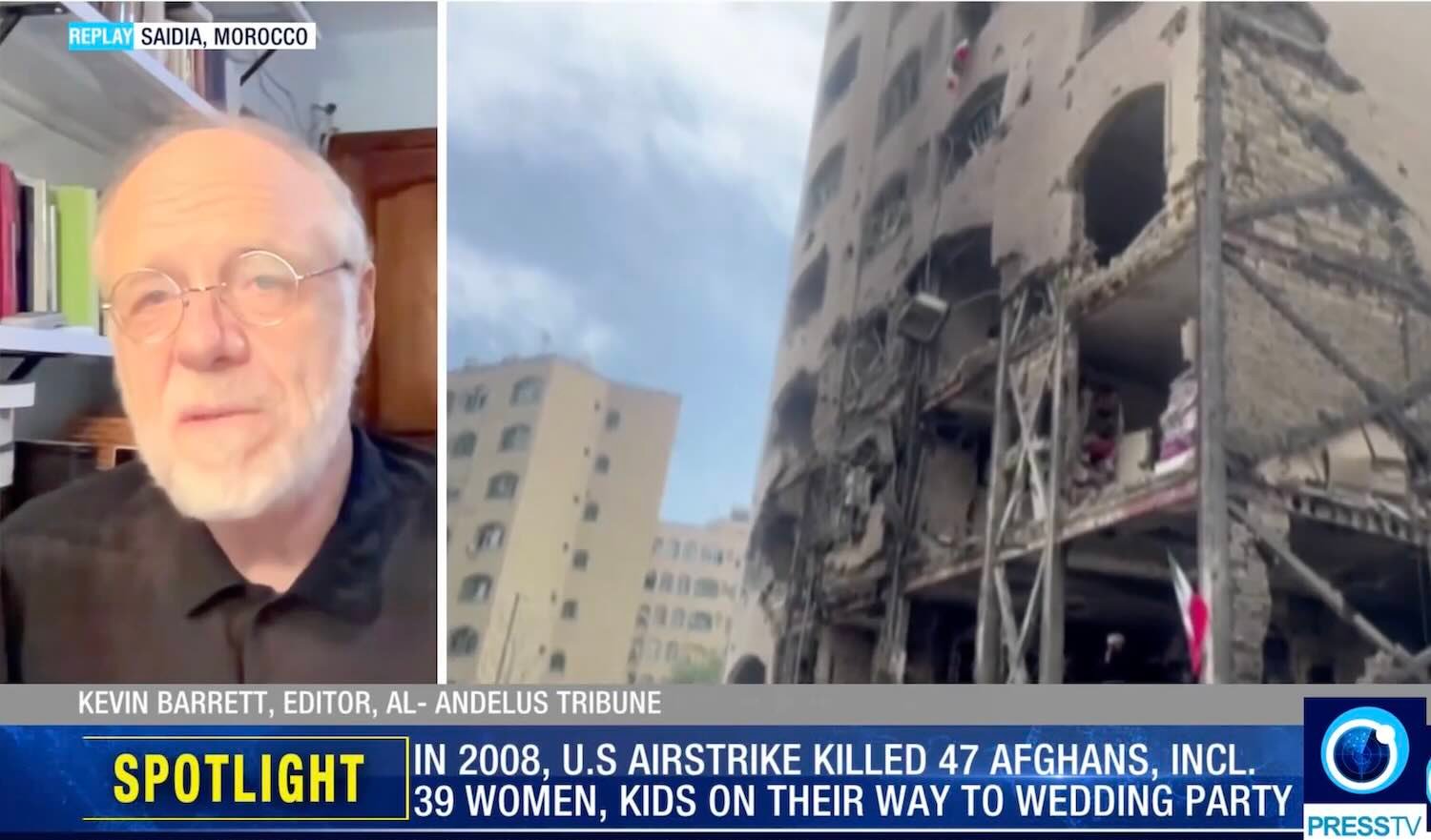
Around 9:30 pm on Tuesday, the US Navy’s most precise glide bomb blew up a wedding party in Sirik, Iran. It evoked memories of similar war crimes: the decimation of a women’s volleyball team in Lamerd, and of course the slaughter of more than 140 girls, along with their teachers, in Minab at the beginning of the war. I appeared on Press TV last night, alongside University of Tehran professor Fouad Izadi, to try to make sense of the seemingly senseless massacres of innocents, paid for by US taxpayers’ dollars.
Transcript
Press TV: The U.S. has again struck civilian targets in Iran, including an attack on a wedding party in the southern city of Sirik that has killed and injured over 70 Iranians, majority of them women and children. The attacks have been condemned by Iran’s foreign ministry and multiple officials, many of whom have reiterated there is no doubt the so-called precision strikes were deliberate. This pattern of targeting civilian infrastructure and massacre of civilians seems to join the U.S. and Israeli regime right at the hip. In the Spotlight program, we’ll take a deep look into its legality, morality, the justification and utilization of said attacks as part of U.S. and Israeli military doctrine.
And now, for our guests. Joining us, Dr. Fouad Izadi, professor at University of Tehran, joining us from the Iranian capital, and Dr. Kevin Barrett, editor at the Al-Andalus Tribune from Sadia, Morocco. Gentlemen, hello to the both of you. Pleasure to have you both on. Professor Izadi, we will start with you, sir.
Condolences to you once again after more civilians have perished here in Iran. In less than six months, sir, Iran has seen hundreds of civilians now killed in attacks on a school, on a wedding, a busy Tehran intersection, or intersections for that matter, bridges, residential infrastructure. Your initial take, Professor, on how we are to process these kinds of attacks?
Fouad Izadi: I think you should process these attacks as war crimes committed by the United States to terrorize the Iranian people. Of course, this is not the first time that Americans have engaged in war crimes. We remember what they did in Vietnam, in Afghanistan, in Iraq, attacking civilians to terrorize the local population so they would submit to the United States.
And this is what they have done in Iran. In some instances, they have even accepted responsibility. Attacking bridges, civilian bridges, is a war crime. Trump proudly accepted responsibility for that. In the last one and a half years of attacks on Iran, they have attacked hospitals, schools, and other civilian infrastructure, in line with what the Israelis have done in Gaza. Israelis have attacked every school, every hospital, every home almost. And this is what the United States is doing to the Iranian people. Trump is upset with the people of Iran because he expected them to help him to become his foot soldiers in achieving his foreign policy goals.
People in Iran, even people who don’t like the current government, know who Trump is, know who Netanyahu is, know the fact that these are genocidal war criminals. And no one is interested in becoming foot soldiers for Trump and Netanyahu. In fact, every night for the last 186, 187 nights, people, Iranians, come to the streets in millions shouting against Trump and Netanyahu. And this is making them (US and Israeli leaders) upset. So they think by repeating the experience in Gaza, they can achieve some goal. If you look at the pictures that are broadcast, the wedding that was hit was right in the middle of a civilian area. There was no excuse.
These missiles are precision missiles. This was done on purpose, and it’s not going to achieve its goals.
Press TV: All right. Thank you. Dr. Barrett, thank you for your patience. Welcome to the conversation, sir. Your initial take on these kinds of attacks, repeatedly carried out by the U.S. and the Israeli regime, to Dr. Fouadi’s point, in Gaza, Lebanon, Iran, Afghanistan, Iraq, And that’s just on this side of the century. If we don’t want to get into Vietnam and the carpet bombing in North Korea, the napalm in Vietnam, the My Lai massacre in Vietnam and whatnot, just this side of the century, there’s an elaborate, well-documented myriad of cases that we could reference.
Kevin Barrett: That’s right. Since the United States became the dominant world power after World War II, it killed somewhere in the neighborhood of 60 million innocent people in its wars and CIA interventions, according to William Blum in his book, Killing Hope. And that was published 20-some years ago. And so it missed the killings in the so-called War on Terror after the false flag attack on 9/11. Of course, we’re coming up on the 25th anniversary of that false flag. And since then, this so-called War on Terror has actually been a war of terror. It’s been a concerted war on civilian populations.
And it’s reached the point now with this current terror war on Iran that everything has turned upside down, because the official discourse of the War on Terror has been that professional militaries, like supposedly the United States’, only target military objectives, while the other side just randomly blows up civilians.
But in fact, in this war, it’s the precise opposite. In this war, Iran has been very, very precise in attacking and devastating American military targets without much civilian collateral damage. Whereas the Americans have not only been blowing up whole schools full of girls, killing 168 people, the initial report, and blowing up this latest wedding party in Sirik.
Of course, they’re experts at attacking wedding parties from the Iraq and Afghanistan wars. But they’re also deliberately and openly announcing that Trump is going after civilian targets, blowing up bridges, blowing up railways and so on, trying to make the civilian population suffer. So Trump is the world’s biggest terrorist.
And the sorts of things that were done during the war on terror to “go after terrorists” actually need to be applied to the real terrorists. And we can only hope and pray that we’ll have a change in the international order soon. We’ll get a real United Nations, we’ll get a real International Criminal Court, and we’ll try all those people and hang them.
Press TV: Thank you. And Dr. Izadi, you mentioned a level of frustration and retribution, maybe, and you mentioned all the Iranians that are standing behind their government, standing before their soil and territorial integrity against the U.S. and Israel. But then the Human Rights Watch in 2003 documented in Iraq extensive use of cluster munitions by U.S. and British forces in populated residential areas producing hundreds of civilian casualties. Also attacks on weddings both in Iraq and Afghanistan since the turn of the century, resulting in hundreds upon hundreds of civilian casualties. So it’s not just Iran, is it? This just seems to be the U.S. and Israeli playbook. You mentioned Gaza. What do you think, are these attacks by design?
Fouad Izadi: You know, they target military sites as well. And then in all cases that you mentioned, Vietnam, Afghanistan, Iraq, Lebanon, other places, they realize that attacking military sites is not enough, because by attacking military sites only, you have a population that is obviously supporting its military against foreign aggression. The people who are in the military come from civilian areas. They are the children of the people who are in cities and villages. And when the United States, and Israel, which is the same thing, don’t achieve their goals by attacking military sites, military people, then they decide that they want to punish ordinary citizens, because at the end of the day, they belong to the same country. They belong to the same people. They are the parents and brothers and sisters of the people who are in the military. So in order to damage or destroy the morale of the military, they think by attacking civilian areas they can make the other side surrender.
They have used atomic bombs attacking civilians, hundreds of thousands of people killed in order to achieve some policy goal. So the United States, since its inception, has been killing civilians in order to achieve the objectives of some politician. And the only problem with that scenario is that in countries, especially countries like Iran, that have a long history and culture of resistance against imperialism, against aggression, against the United States and Israel… When you’re facing a country like Iran, this is going to backfire. And this is going to unite the people. In fact, I can argue that Trump and Netanyahu have managed to unite Iranians more than any Iranian politician could ever do. As I said, even if you don’t like the government, you don’t want to go to a wedding and not come back. You don’t want to see your local hospital attacked. You don’t want the local bridge to be destroyed.
So this is going to make Iranians more united. And this is going to result in these people actually asking government officials to respond to the United States in a more forceful manner. There’s going to be a public opinion push on Iranian politicians demanding a greater response so these attacks don’t happen again.
Press TV: And Dr. Barrett, I like to put that same question to you. The policy here, how you perceive it? Human Rights Watch in “Baghdad killing” in 2003 said over 120 civilians were killed in less than 13 days. It said their probe found a pattern of over-aggressive tactics Indiscriminate shooting in residential neighborhoods and excessive reliance on lethal force. What’s your idea on this of war policy? It does not sound like an anomaly restricted just to Iran or Afghanistan and Iraq, for that matter. It seems like, to Dr. Izadi’s point, that it’s been prevalent throughout the U.S.’s war engagements for decades, if not centuries.
Kevin Barrett: Well, this illustrates how the United States is actually at war not just with leadership that it doesn’t like. Though that’s what it says. It tells us that it supports the Iranian people. It just doesn’t like their leadership.
And that kind of rhetoric, demonizing leaders, obscures the fact that the United States is actually at war with the people. And, of course, the Zionist entity is at war with the people of Palestine even more, obviously. And the reason is that the United States is trying to extract resources from these countries, and it needs local comprador elites to cooperate with it and basically rob these countries and rob their people. And so the honest politicians and leaders in these countries are the enemies of the United States, because they want independence for their countries and they want a good deal for their people. Back in 1953, Mohamed Mossadegh found out the hard way that dealing with the United States in these kinds of matters was very difficult if you’re an honest politician.
So they’re at war with the people, and that’s, I believe, part of the reason that when the United States goes and intervenes in these countries, it tends to massacre civilians vastly more than would serve its interests. It actually would win the so-called hearts and minds much better if it was disciplined and careful in trying to avoid collateral damage. But instead, they wage these wars of terror. And it hasn’t worked. The most powerful nation on earth has lost war after war.
They lost in Vietnam, and they lost again in Iraq. They lost in Afghanistan. But this current loss to Iran is shaping up to be really the mother of all defeats for the United States and possibly the end of its empire, because Iran is chasing the United States out of the region using very precise and powerful military force that the United States apparently now lacks. So all they can do is attack civilians.
Press TV: Thanks, Kevin. And Dr. Izadi, a reporter for the New York Times, Christian Tribirth said the U.S. attack yesterday in the wedding in Sirik is no mistake, and that remnants of the weapon recovered point to it being a Boeing-produced SLAM-ER, I’m thinking it’s a hyphen ER, SLAM-ER missile, the most precise munition of its kind in the U.S. naval arsenal. How’s that for making it tough to chalk this up as a missed target or a weapon gone astray? And when we look at Lamerd, when we look at Sirik, when we look at Minab, is there any doubt with respect to intent here if these were deliberate or not from your perspective, doctor?
Fouad Izadi: You know, Minab was six months ago. We have video of American Tomahawk missiles hitting the school. And if you ask American politicians, people at the Pentagon, about the reason why they hit this school, they claim that they did not do it, and then they say that the issue is under investigation.
So this is the nature of the United States. Politicians in the United States lie. They lie to their people. They lie to the world. And the good thing is that everybody realizes who they are. It’s not just the people of Iran who realize who U.S. government officials are, the type of people that they are.
Your viewers know who they are. Other people internationally know who they are. And so their claims of innocence, no one believes. And the reality is that this is not going to be the last time that the United States uses terror to punish the people who are electing politicians that are serving their country, that are supporting a military that is protecting the country. The thinking in Washington is that If we punish these people more, somehow we can find some success in the wars that we wage. And this is the mentality that the United States has had since the beginning, the way they killed indigenous people in the American continent, the way they killed Africans when they enslaved them.
They even sometimes use the same terminology. The other day, the U.S. Secretary of Treasury talked about a noose, “putting a noose on Iran”—the same way they hanged Africans, slaves that were supposed to be punished, who were not submitting the way the slave masters wanted them to submit.
They’re even using the same technology, the same terminology against Iran. So many of your viewers may not be Iranians, but I don’t think anywhere in the world you can find people that have not been affected negatively by the United States. People all over the world have suffered from U.S. policies.
Press TV: And speaking of accountability, Dr. Barrett, do you remember Fatoua bin Souda, the chief ICC prosecutor during Trump’s first term, wanted to launch an ICC probe into war crimes by U.S. and British forces in Iraq and in Afghanistan. Donald Trump specifically villainized her, revoked her travel visas, her and her three people on her team.
None of them are around any more. None of them are part of the ICC prosecution team any more. They got huge blowback. The probe was never launched. We see the same exact thing repeated by the Israeli regime. They do not allow UN teams into Gaza, or even media for that matter, or the occupied West Bank.
And they barely even allowed US politicians into those respective territories. A lot of coincidence there, but your thoughts on this policy of shielding yourself from all kinds of accountability?
Kevin Barrett: Well, indeed, they’re basically confessing that they’re criminals when they block the ICC and refuse to allow international organizations access to the war zones. And the U.S. and and especially the Zionist entity are notorious for essentially having a policy of protecting their war criminals. And they do that because they are systematically and deliberately committing war crimes as a matter of policy. Which means that the entire chain of command, both political, military, intelligence, the whole top level of the government, is exposed to prosecution for war crimes. These people are war criminals, and they know it. And they even admit it. They brag about blowing up civilian targets.
And so, naturally, they try to escape accountability. And they can get away with it for a while. The problem, though, for them is that this empire is crumbling, and their strength is rapidly diminishing. They are badly losing this war. And when the smoke clears, there’s going to be a new international order, and the United States is not going to be anywhere near the world’s most powerful country anymore. And we may actually have a chance at getting some accountability and—again—trying, convicting, and hanging these people.
Press TV: And we have time for one more question. Really quick, Dr. Izadi, we look at the figures, we can talk about the civilian casualties in Iran, in Afghanistan, and neighboring Iraq. I’m just going to mention Afghanistan. We don’t have much time left. 176,000 people killed between 2001 and 2021, and total disregard for lives
What I wanted you to speak on before we wrap this up, because 501 Ukrainians were killed in a town called Busha in Ukraine in April of 2022, including 19 women and children, and it got huge blowback from the international community because 501 so-called civilians were killed in that town. But then when we talk about hundreds of thousands, it doesn’t get that kind of coverage. Why?
Fouad Izadi: Because generally, corporate media outlets in the West are racist. And killing civilians, whether they’re Iranians or Afghans or Ukrainians or Russians, should be condemned. But they have double standards. If you have blonde hair and blue eyes, you’re going to get more serious coverage by the Western media outlets.
That’s why there is Press TV to be the voice of the voiceless and not practice the racism that is very much present in corporate media outlets in the West and Western politicians in general. You saw what these Western governments did when it came to the genocide in Gaza, with the exception of one or two. They fully supported it. They helped the genocidal regime to continue that genocide. And this is the last word I’ll have for you. You know, Trump is about 80 years old, so we may not be able to get him. But younger people that are committing these crimes, Pete Hegseth, people in the Pentagon, these people are young enough for the Iranian side and others who have been affected by them negatively, the victims of their crimes, to actually get them to pay for the crimes that they did. So if they’re watching Press TV, I hope they have good attorneys.
Press TV: Gentlemen, always a pleasure. Thank you both sincerely for joining us on our program. Dr. Farid Izadi, the professor at the University of Tehran, joining us for the Iranian capital, as well as Dr. Kevin Barrett, editor at Al-Andalus Tribune from Sadia, Morocco. And viewers, that’s a wrap for this segment of your Spotlight program. Thank you for tuning in, and goodbye for now.